Hardware-as-Regularization

Enhancing Data Consistency in Imitation Learning
via an Adjustable Passive Compliant Leader Arm

Hideyuki Ichiwara1, Yushi Kaida1, Hirokazu Ishida1
1SB Intuitions Corporation
CoRL 2026, Austin, Texas, USA

TL;DR: A ∼\$100, 3D-printed spiral-spring joint pulls a passive leader arm toward a user-defined neutral posture. This physical prior acts as joint-space $L_2$ regularization and makes demonstrations consistent enough to double downstream success.

3.9×

lower joint std than naive GELLO
(5.17° vs. 20.06°)

2×

success on Block Stacking
(73.3% vs. 36.7%)

∼\$100

per arm, fully 3D-printable
zero latency, no motors

Abstract

Low-cost passive leader arms enable scalable data collection for imitation learning, but their lack of restoring forces leaves redundant joints unconstrained, yielding highly inconsistent joint-space trajectories. We address this with a low-cost passive joint module (an adjustable mechanical clutch and a 3D-printed spiral spring) that pulls each joint toward a user-defined neutral posture. This passive restoring force acts as a physical prior equivalent to joint-space $L_2$ regularization (“Hardware-as-Regularization”), improving kinematic consistency with shorter completion time than an unregularized arm and preserved movement smoothness.

Experiments show substantial variance reduction over a naive passive arm, trajectory consistency on par with an active virtual spring of the same actuator class, and substantially higher downstream success rates (e.g., 73.3% vs. 36.7% on Block Stacking); a stiffness sweep shows consistency degrading monotonically as stiffness decreases, confirming that mechanical stiffness behaves like a regularization weight.

Problem

Passive Leader Arms Drift in the Null-Space

Low-cost passive leader arms (e.g., GELLO) have no restoring forces, so their redundant joints drift freely in the null-space under gravity, friction, and hand tremor. Operators often have to hold the arm up with their other hand, and the resulting demonstrations have inconsistent, multimodal joint-space trajectories that hurt downstream imitation learning.

On a naive passive arm, null-space joints droop under their own weight.

Method

A Spring Is an $L_2$ Regularizer

We add a purely mechanical joint module — a 3D-printed spiral spring with an adjustable Hirth-coupling clutch — that pulls each joint toward a user-defined neutral posture $q_0$. Assuming the operator minimizes physical exertion, teleoperation becomes $$ \min_{q} \; \frac{1}{2} (q - q_0)^T K (q - q_0) \quad \text{subject to} \quad f(q) = x_d, $$ where $K$ is the spring stiffness, $f$ the forward kinematics, and $x_d$ the target pose. This is Tikhonov ($L_2$) regularization in joint space: the problem is strongly convex, so the arm settles into a unique posture. The hardware thus acts as a passive, zero-latency prior that makes demonstrations consistent.
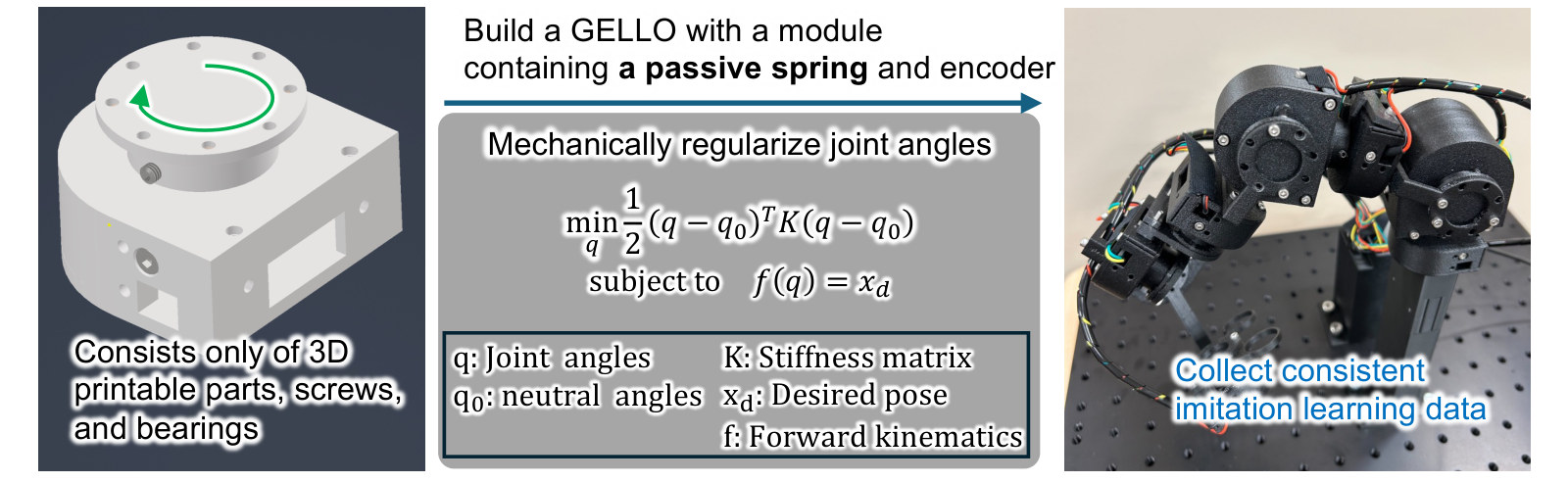
Overview: a 3D-printable joint module with a passive spring and encoder, the regularized optimization problem, and the assembled leader arm.
Building a GELLO from the module mechanically regularizes joint angles.

Design Choice

Why a Passive Spring?

An active virtual spring can also add restoring force, but it needs current-controlled motors and runs in a discrete-time control loop. A physical spring gives the same prior in continuous time, injects no energy, and keeps the cost of a passive arm.

Naive GELLOGELLO w/ virtual springOurs
Restoring force✗ None✓ Motor torque✓ Spiral spring
Data consistency✗ Low✓ High✓ High
Latency✓ Zero✗ Control loop✓ Zero
Stability✓ Passive✗ Conditionally stable✓ Passive
Cost∼\$200✗ >\$700✓ ∼\$100

Hardware

A Fully 3D-Printable Joint Module

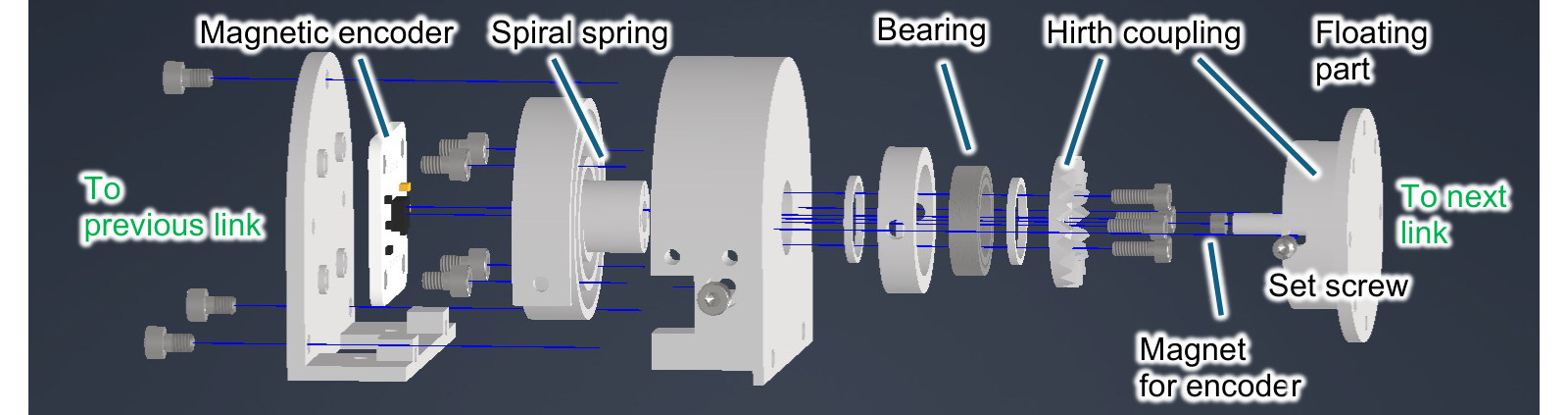
Exploded view of the joint module: magnetic encoder, spiral spring, bearing, Hirth coupling, floating part, set screw, and encoder magnet.
Exploded view of the joint module.

The module uses only 3D-printed parts (PC spring, ABS body), screws, bearings, and a magnetic encoder — about \$100 per arm, vs. ∼\$200 for a naive GELLO and >\$700 for a virtual-spring setup.

  • The planar spiral spring deflects in both directions and is well suited to FDM printing.
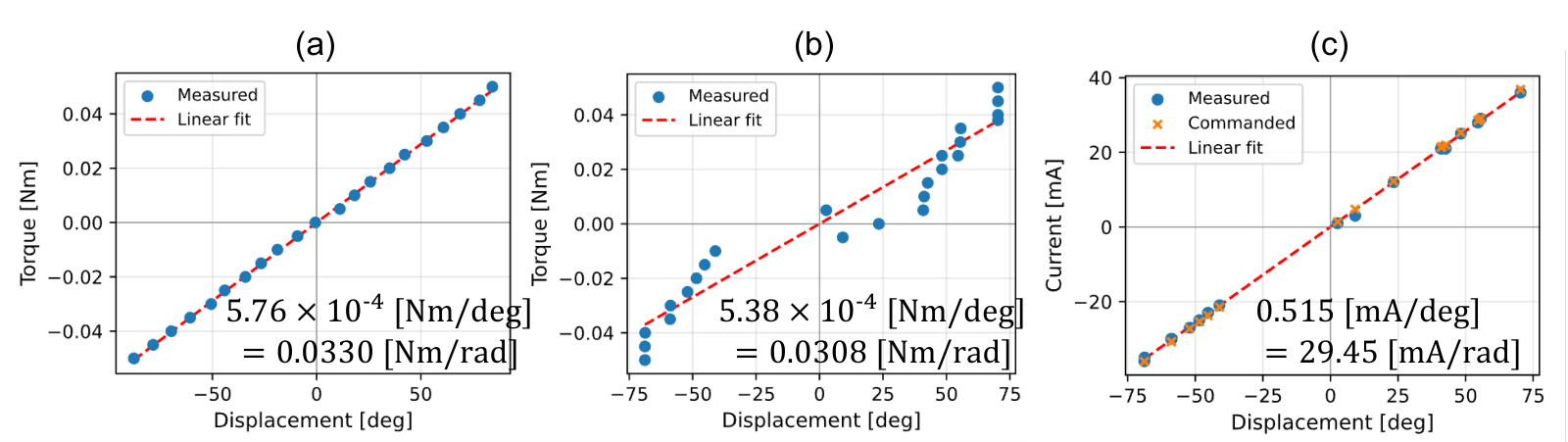
  • Stiffness follows $K = Ebt^3/(12L)$: measured 0.0330 Nm/rad (theory 0.025), consistent across prints (0.0322–0.0335) and after 1,000 cycles. Gravity-loaded J2/J4 use stiffer springs.
Does a passive spring ring?

Released without hand contact, the arm rings briefly ($\zeta \approx 0.09$–$0.16$, settling in ∼1–5 s); during operation the operator's hand damps it.

Internal Mechanism

Opening a module reveals the spiral spring. Its spring side meshes with the floating part (attached to the next link) via a Hirth coupling, and a magnet on the floating part is read by a coaxial encoder.

Adjusting the Neutral Posture

Loosen the set screws, rotate, and re-tighten to shift the neutral posture $q_0$ in 20° steps — about 2–3 minutes for all seven joints.

User Study

Consistent for Every Operator

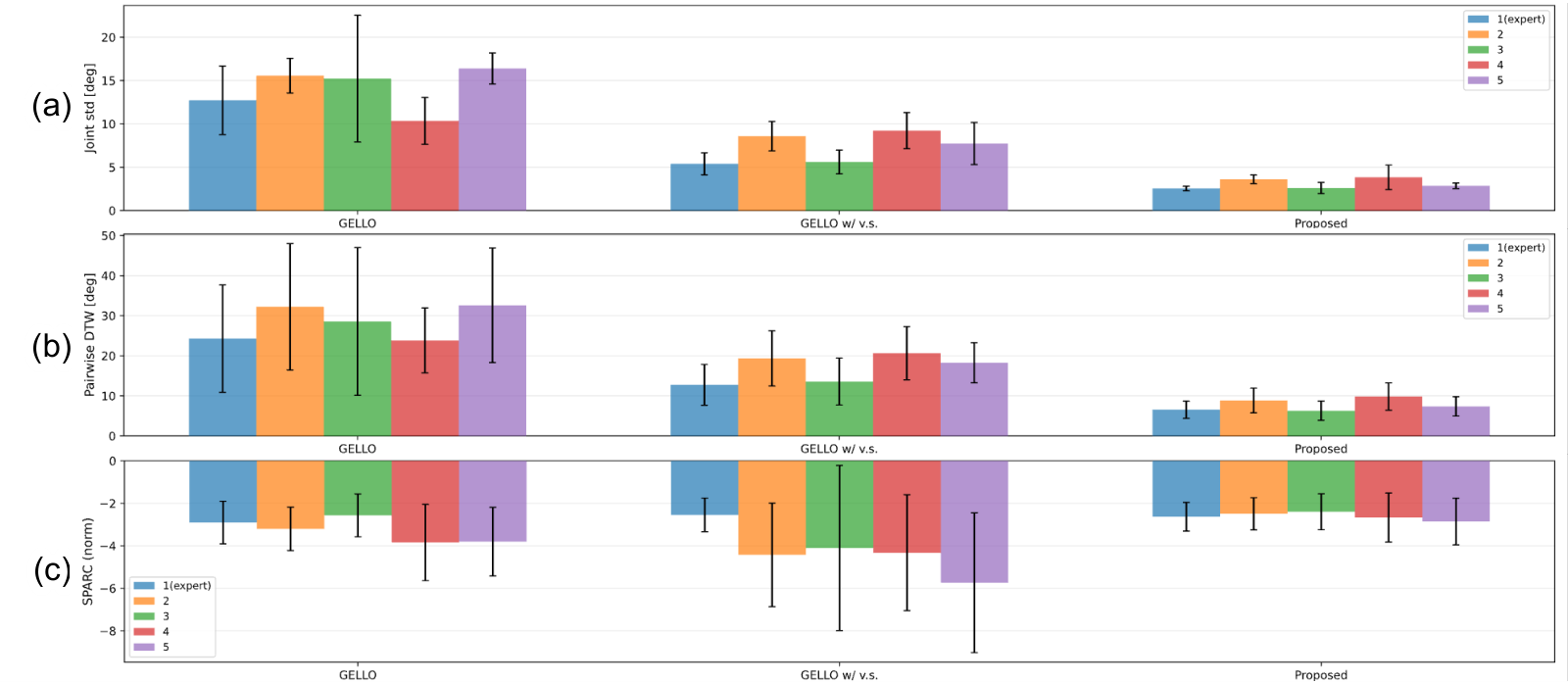
Five operators (one expert, four novices) teleoperated a simulated 7-DoF OpenArm to four target poses (10 trials each) with three leader devices in randomized order: naive GELLO, GELLO with an active virtual spring, and ours. Our module is the most consistent for every operator, with movement smoothness preserved.

Same operator, three leader devices (2× speed).
MetricNaive GELLOGELLO w/ virtual springOurs
Joint std [deg] ↓20.06 ± 5.1310.25 ± 1.465.17 ± 0.36
Pairwise DTW [deg] ↓37.19 ± 18.6422.01 ± 7.3911.82 ± 3.91
SPARC [-] (closer to 0 = smoother)−3.26 ± 1.42−4.23 ± 3.00−2.61 ± 0.94
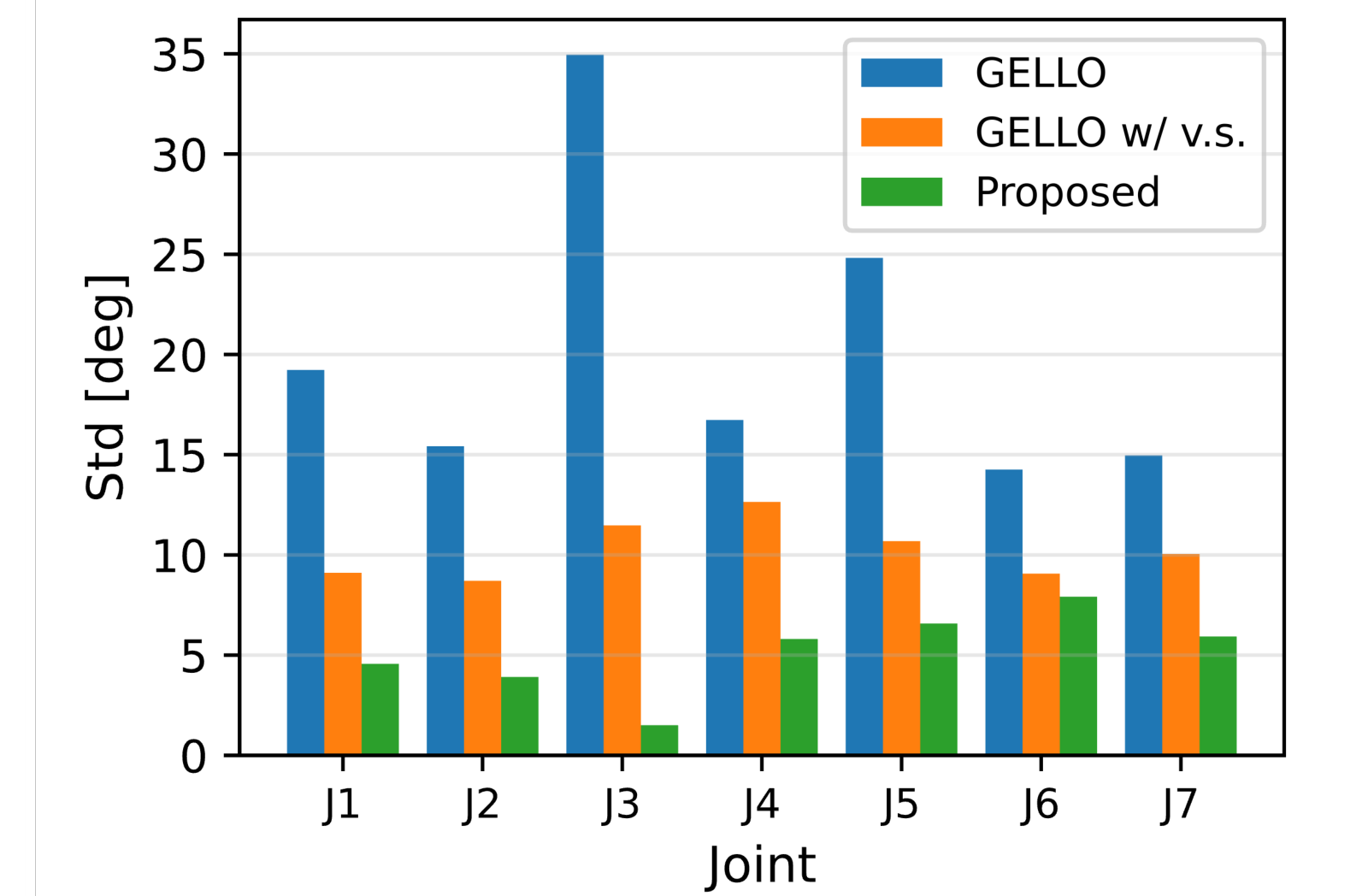
Per-joint standard deviation of joint angles for naive GELLO, GELLO with virtual spring, and the proposed module.
Per-joint standard deviation across leader devices.

Expert completion time: 4.42 s with our module vs. 6.56 s with the naive arm ($p=7.6\times10^{-3}$).

Per-operator results
Per-operator joint std, pairwise DTW, and SPARC for the three devices.
(a) Joint std, (b) pairwise DTW, (c) SPARC per operator. User 1 is the expert; Users 2–5 are novices.

Ablation

Stiffness as a Regularization Weight

With the expert alone, consistency improves monotonically with stiffness ($K=0$ (naive) $\rightarrow K/2 \rightarrow K$). The virtual spring tuned to $K$ is worse than even $K/2$, consistent with the backlash and dead zones of its geared motor.

Metric$K=0$ (naive)$K/2$$K$ (ours)Virtual spring (≈$K$)
Joint std [deg] ↓12.723.852.555.39
Pairwise DTW [deg] ↓24.2010.176.8613.07
Torque versus displacement: linear for the passive spring, with dead zones for the virtual spring; the virtual spring's current is linear.
(a) Our spring is linear. (b) The virtual spring shows dead zones in torque, (c) even though its motor current is linear.

Imitation Learning

Consistent Data, 2× Higher Success

We trained ACT on demonstrations from each device (Pick & Place: 60, Block Stacking: 80) and ran 30 rollouts per task. The expert operated one-handed in all conditions. Naive demonstrations are as smooth but far less consistent: multimodality, not smoothness, causes the drop.

TaskMetricNaive GELLOGELLO w/ virtual springOurs
Pick & PlaceSuccess rate [%] ↑53.396.796.7
Pairwise DTW of data [deg] ↓23.2311.718.32
Block StackingSuccess rate [%] ↑36.766.773.3
Pairwise DTW of data [deg] ↓16.3510.238.24
Autonomous ACT rollouts on the real 7-DoF arm.
Statistics and protocol notes

Naive vs. ours: $p=1.7\times10^{-4}$ (Pick & Place) and $p=8.9\times10^{-3}$ (Block Stacking); ours vs. virtual spring is not significantly different on either task. On Block Stacking, ours is smoother than the virtual spring (SPARC $-3.19$ vs. $-3.89$, $p=1.7\times10^{-29}$).

Naive GELLO's droop forced emergency stops in ∼12.5% of collection attempts. The naive condition was collected last, so practice effects favor it.

BibTeX

@inproceedings{ichiwara2026hardware,
  author    = {Ichiwara, Hideyuki and Kaida, Yushi and Ishida, Hirokazu},
  title     = {Hardware-as-Regularization: Enhancing Data Consistency in Imitation Learning via an Adjustable Passive Compliant Leader Arm},
  booktitle = {Conference on Robot Learning (CoRL)},
  year      = {2026},
}